


APP Remains Registered as Owerri Court Rules, While Abuja Court Orders Deregistration — Conflicting Judgments Create Legal Uncertainty Over Party’s Future
Two Federal High Courts on Monday, June 15, 2026, delivered conflicting decisions over the legal status of the Action Peoples Party (APP), creating uncertainty over the party’s continued recognition and placing the Independent National Electoral Commission (INEC) in a complex legal position.
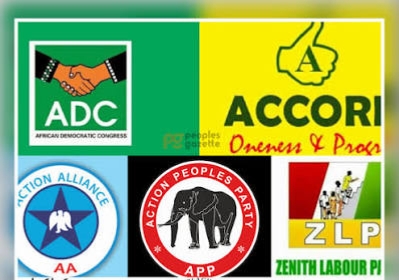
While the Federal High Court sitting in Owerri ruled that APP was never lawfully deregistered and remains a validly registered political party, the Federal High Court in Abuja, in a separate judgment delivered the same day, ordered INEC to deregister APP alongside four other political parties — the African Democratic Congress (ADC), Action Alliance (AA), Accord Party and Zenith Labour Party (ZLP).
The contradictory rulings mean that two courts of coordinate jurisdiction have reached different conclusions on the same political party, raising questions about the next legal steps and the position INEC should adopt pending possible appellate intervention.

Owerri Court: APP Was Never Deregistered
In Owerri, Justice I.N. Oweibo dismissed a suit filed by Mazi Ngororo Franklin Chinazo seeking an order compelling INEC to remove APP from the register of political parties.
The plaintiff had argued that APP was among the political parties affected by INEC’s 2020 deregistration exercise and therefore should not have participated in subsequent elections.
However, the court held that the plaintiff failed to establish that APP had ever been legally deregistered.
Justice Oweibo found that following INEC’s 2020 announcement, APP had approached the Federal Capital Territory High Court in Abuja and obtained an order restraining INEC from taking steps affecting the party’s registration status pending the determination of judicial review proceedings.
The court held that the order was not a mere temporary injunction but a judicial review stay that remained effective until the substantive matter was determined or the court directed otherwise.
Based on that reasoning, Justice Oweibo ruled that INEC was not legally free to deregister APP during the 2020 exercise.
The court also held that the Supreme Court decision relied upon by the plaintiff did not directly determine APP’s status because APP was not a party to that case.
Justice Oweibo dismissed the suit and awarded N20 million in costs against the plaintiff, directing payment of N10 million each to INEC and APP.
Abuja Court: INEC Ordered To Deregister APP, ADC, Others
In a separate judgment in Abuja, Justice Peter Lifu ordered INEC to deregister APP and four other parties after holding that they failed to satisfy constitutional requirements for continued recognition as political parties.
The suit, marked FHC/ABJ/CS/2637/2026, was filed by the Incorporated Trustees of the National Forum of Former Legislators.
Justice Lifu held that the affected parties failed to meet the required electoral performance threshold under Section 225A of the 1999 Constitution, including securing at least 25 percent of votes in any state during the presidential election or winning an elective position.
The court directed INEC to remove the parties from its register and barred them from participating in future electoral activities, including the 2027 general elections.
Court of Appeal Intervention
Earlier in the proceedings, the Court of Appeal had intervened in relation to the Abuja case by granting a stay of proceedings, which temporarily affected the timing of the Federal High Court proceedings. However, available reports reviewed do not confirm a subsequent Court of Appeal order staying execution of Justice Lifu’s final judgment after it was delivered.
Legal Implication
The two Federal High Court decisions now present a major legal dilemma.
The Owerri judgment recognises APP as an existing political party protected by a subsisting court order, while the Abuja judgment directs INEC to deregister APP for allegedly failing to meet constitutional requirements.
Since both decisions were delivered by courts of equal standing, neither automatically overrides the other. The final resolution may depend on appeals and the determination of the higher courts.
For INEC, the conflicting judgments create an immediate challenge: one court has affirmed APP’s legal existence, while another has ordered its removal from the political party register.
Until the appellate courts provide further clarification, APP’s legal status remains uncertain.
— Emeka Amaefula—-+234(0)8111813069—