


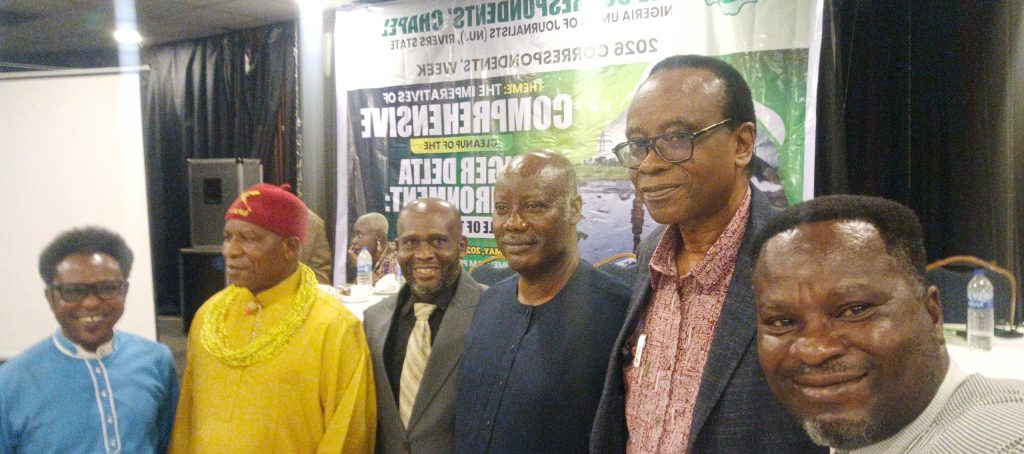
NNIMMO BASSEY DEMANDS IMMEDIATE ENVIRONMENTAL AUDIT OF NIGER DELTA AMID ESCALATING OIL POLLUTION CRISIS
By Emeka Amaefula
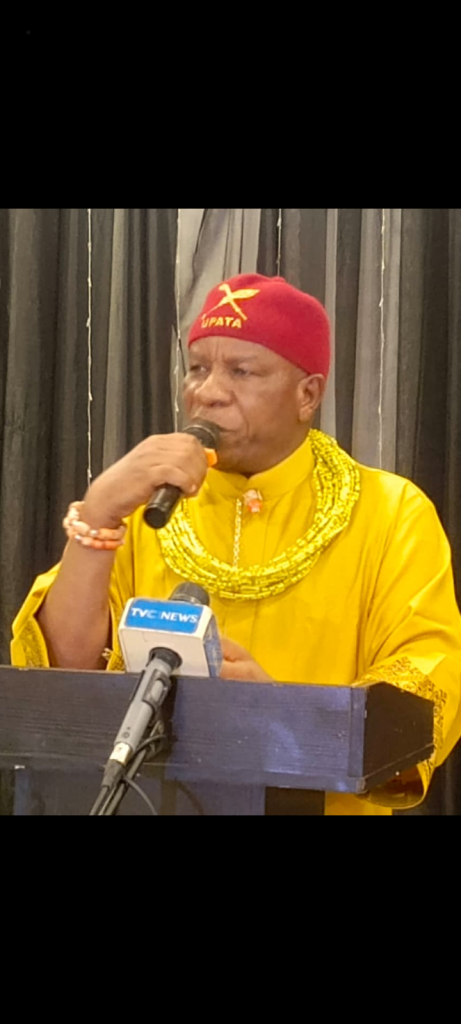
Environmental rights activist and Executive Director of the Health of Mother Earth Foundation, Nnimmo Bassey, has called on the Federal Government to immediately commence a comprehensive environmental audit of the Niger Delta as a critical first step toward addressing decades of ecological devastation caused by oil exploration and exploitation in the region.
Bassey made the passionate appeal on Monday, May 18, 2026, while delivering the keynote address at the opening ceremony of the 2026 Correspondents’ Chapel Week organised by the Nigeria Union of Journalists in Port Harcourt, Rivers State. The event, held at the Hotel Presidential along Aba Road, was themed: “The Imperative of Comprehensive Cleanup of the Niger Delta Environment: Role of the Media.”
Addressing journalists, media practitioners, environmental advocates, and public officials at the gathering, Bassey declared that the period of endless debates and political rhetoric over the cleanup of the Niger Delta had passed, insisting that the time for concrete action had arrived.
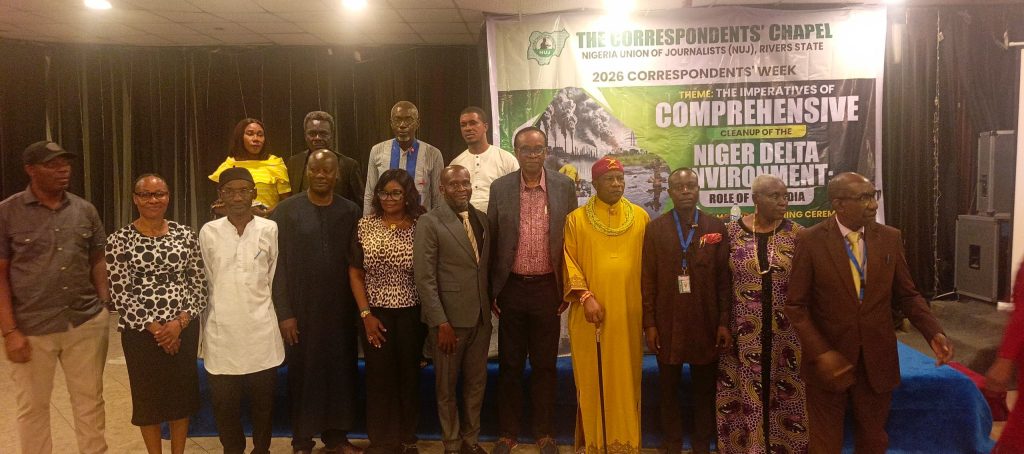
According to him, the Federal Government must urgently undertake a scientific and independent audit of the entire Niger Delta environment to determine the true scale of contamination affecting land, rivers, groundwater, forests, and communities across the oil-producing region.
“The era of arguing whether the Niger Delta should be cleaned or not is over. The time now is to begin the environmental audit of the region and immediately commence comprehensive remediation and cleanup,” Bassey stated.
He lamented that despite the enormous wealth generated from crude oil exploration in the Niger Delta over several decades, the people of the region have continued to suffer environmental degradation, poverty, disease, unemployment, and destruction of their traditional means of livelihood.
Drawing attention to the alarming scale of oil pollution in the region, Bassey said the quantity of crude oil spilled in the Niger Delta within a single day is comparable to the entire Exxon Valdez disaster in Alaska, one of the worst oil spills in global history. He also referenced the April 20, 2010 Deepwater Horizon catastrophe in the Gulf of Mexico, which discharged approximately 134 million gallons of crude oil into the ocean.
The environmental activist accused regulatory agencies, political authorities, and oil industry operators of maintaining what he described as a disturbing silence over the worsening environmental crisis in the Niger Delta.
“Nobody seems to care about the environment of the Niger Delta. Communities are abandoned while pollution continues daily. The destruction has become normalised, and that is unacceptable,” he said.
Bassey further argued that Nigeria was economically stronger and socially more productive before the discovery and dominance of crude oil in the nation’s economy. According to him, dependence on petroleum revenue weakened agriculture, destroyed local industries, undermined infrastructural growth, and entrenched a dangerous mono-economy.
“Nigeria was better off before oil became the backbone of the economy. Before crude oil, we had a thriving agricultural sector, functional infrastructure, strong educational institutions, and productive industries. Nigeria was once one of the leading exporters of food and agricultural products before oil revenue changed the economic direction of the country,” he declared.
He criticised what he described as the continuation of colonial-style extraction in which raw materials are taken from local communities while the people remain impoverished and environmentally endangered. Bassey urged Nigeria and other African countries to explore stronger economic alliances with blocs such as BRICS in order to reduce dependence on Western economic structures and multinational interests.
The activist warned that failure to clean up the Niger Delta before the global transition away from fossil fuels could leave the region permanently devastated without any hope of meaningful restoration.
“If the Niger Delta is not cleaned up now while oil is still generating profit, then the people of the region may never get justice after the world moves away from fossil fuels,” he warned.
Bassey strongly condemned multinational oil companies operating in Nigeria, accusing them of prioritising profit over human lives and environmental safety. He insisted that corporations responsible for pollution must not be allowed to evade accountability.
“No company has the moral right to poison our water, destroy our soil, pollute our air, and then walk away with billions in profit while communities suffer sickness and poverty. Clean up the mess. What is happening in the Niger Delta is immoral, unjust, and completely unacceptable,” he stressed.
He specifically mentioned the Nigerian National Petroleum Company Limited, Shell, Chevron, and Renaissance Africa Energy Company as operators that must be held accountable for environmental destruction in the region.
Rejecting the common narrative that most oil spills are caused solely by pipeline vandalism and crude oil theft, Bassey argued that many of the pipelines traversing communities in the Niger Delta are obsolete and have long exceeded their operational lifespan.
“Pipelines laid more than 50 years ago have expired and should have been replaced long ago. Many of them are corroded, weak, and unsafe. Yet they remain in use while communities bear the consequences of spills and leakages,” he said.
He also condemned the continued practice of gas flaring in the Niger Delta, describing it as a gross violation of environmental and human rights despite several court judgments prohibiting the practice.
“Gas flaring is an iniquity. It is a violation of the right to life and the right to a healthy environment. Yet it continues openly in many communities,” he added.
Bassey noted that many affected communities are increasingly seeking justice in foreign courts because judgments delivered by Nigerian courts are often ignored or poorly enforced by powerful oil corporations. He further accused some multinational companies of divesting their assets and restructuring ownership arrangements in ways designed to avoid environmental liabilities and compensation obligations.
He charged journalists and media organisations to sustain public attention on the plight of the Niger Delta, stressing that the media must continue to expose environmental injustice and compel government authorities to act responsibly.
“The media must not allow this issue to disappear from public discourse. Government can no longer pretend that everything is normal in the Niger Delta while communities continue to suffer from pollution, contaminated water, destroyed farmlands, and health hazards,” he charged.
Other speakers at the event, including Professor Silva Opuala Charles, emphasised that achieving a functional blue economy in the Niger Delta would remain impossible without first undertaking a comprehensive environmental cleanup. Some estimates presented at the gathering projected that restoring the devastated ecosystem of the region could require over 20 billion dollars.
Bassey also cited findings from Ogale community in Eleme Local Government Area of Rivers State, where he said benzene contamination discovered in groundwater more than six feet beneath the soil had exceeded internationally accepted safety standards, posing severe health risks to residents and surrounding communities.
He warned that continued neglect of the environmental crisis could have devastating consequences for future generations if urgent intervention is not undertaken.
— Emeka Amaefula
+234(0)8111813069