



COUNTDOWN TO APC 2026 NATIONAL CONVENTION BEGINS AS PARTY UNVEILS NATIONWIDE CONGRESS SCHEDULE SPANNING WARDS, LGAS, STATES AND ZONES
By Emeka Amaefula
The All Progressives Congress (APC) has formally set the stage for a far-reaching internal reorganisation with the release of an expansive and meticulously structured timetable for its 2025/2026 nationwide congresses, a move widely seen as a strategic effort to consolidate internal democracy, manage internal power shifts and reposition the ruling party ahead of future electoral contests.
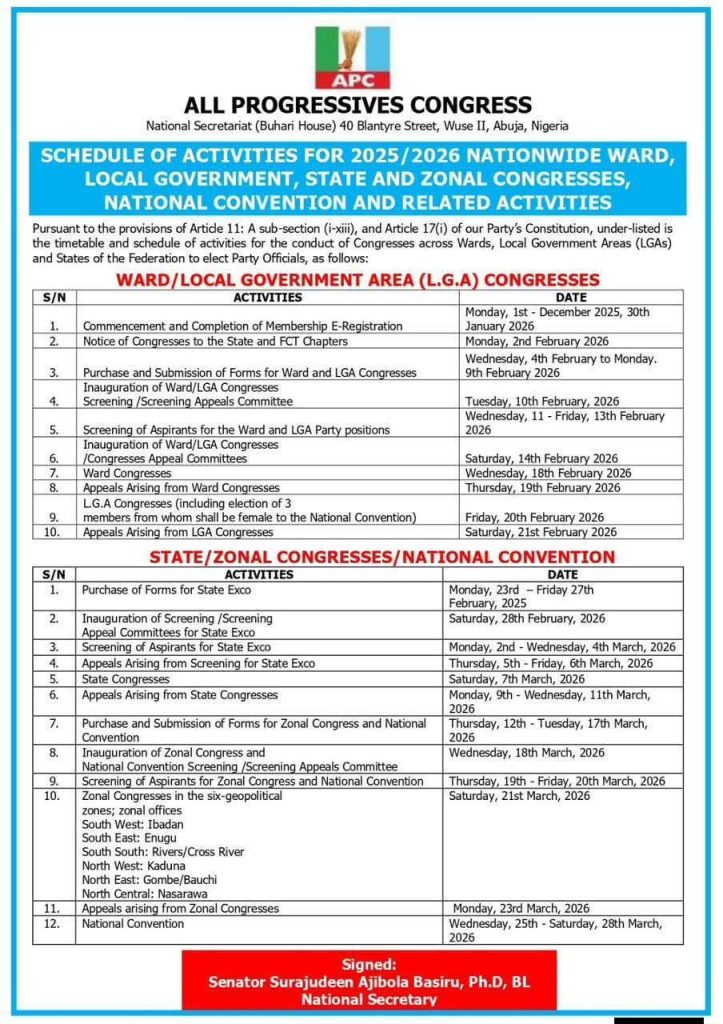
The timetable, issued by the party’s National Secretariat at Buhari House, Abuja, and anchored on the provisions of Articles 11 and 17 of the APC Constitution, provides a clear roadmap from grassroots mobilisation to the emergence of national leadership at the party’s National Convention scheduled to hold from March 25 to March 28, 2026. Political watchers view the document as both a procedural guide and a strong political signal that the APC leadership is determined to enforce order, discipline and inclusiveness in its internal processes.
Central to the exercise is the early commencement of a nationwide membership e-registration, slated to run from December 1, 2025, to January 30, 2026. Observers say this digital registration drive underscores the party’s intention to sanitize its membership register, reduce disputes that have historically trailed congresses and establish a credible database capable of withstanding internal and legal scrutiny. By prioritizing technology and uniform timelines, the APC appears keen on enhancing transparency and restoring confidence among its rank and file.

The development is expected to have significant political implications in Rivers State, where prior to December 2025 the party was largely fragmented along factional lines. The factions included one led by Chief Tony Chidugam Okocha, reputed to enjoy the backing of President Bola Ahmed Tinubu, and another associated with Chief Emeka Beke, an ally of former Governor Chibuike Rotimi Amaechi and Pastor Tonye Cole. The defection of Governor Siminalayi Fubara to the APC, which effectively positioned him as the party’s leader in the state, has since altered the internal balance of power.
Political insiders believe the new reality has considerably diminished the influence of Chief Okocha, who may now be expected to focus more on his role as Rivers State representative on the 7th Management Board of the Niger Delta Development Commission (NDDC). With Governor Fubara widely believed to be positioning himself for a second-term re-election bid, the forthcoming congresses are seen as a critical opportunity for him to re-strategise and consolidate control of party structures across the state.
There are strong indications that the governor may leverage the congress process to integrate loyalists drawn largely from the All People’s Party (APP), which served as the political platform used during his struggle with his former political ally, Nyesom Ezenwo Wike. These loyalists are expected to form the core of emerging APC structures across the 319 wards and 23 local government areas of Rivers State ahead of future party primaries for elective offices.
From February 2026, the congress process will move fully to the grassroots, with ward and local government congresses forming the foundation of the exercise. These activities will be preceded by the sale and submission of nomination forms, screening of aspirants and the inauguration of appeal committees to address grievances. Ward congresses are expected to hold in mid-February, followed closely by local government congresses, including the election of delegates to the National Convention, with specific provisions made to ensure female representation.
Analysts note that this phased, bottom-up approach—progressing from wards to local governments, states and zones—reflects a deliberate strategy to strengthen the party’s grassroots base and reduce factional tensions. By allowing party members at every level to participate actively in leadership emergence, the APC hopes to foster a sense of ownership that could help minimize post-congress disputes.
The political contest is expected to intensify in March 2026 with the conduct of state congresses on March 7, following the conclusion of screening and appeals. Attention will then shift to the zonal level, where congresses will be held across the six geopolitical zones—Ibadan for the South West, Enugu for the South East, Rivers/Cross River for the South South, Kaduna for the North West, Gombe/Bauchi for the North East and Nasarawa for the North Central—on March 21, 2026. These zonal congresses are widely regarded as critical power-balancing platforms ahead of the national convention.
The entire process will culminate in the APC National Convention later in March 2026, where national officers of the party are expected to emerge and the party’s ideological direction and leadership cohesion for the coming years will be defined.Many
within the party see the convention as a decisive moment that could reshape internal alignments and determine how united the APC enters its next political cycle.
The released Timetable which was signed by the APC National Secretary, Senator Surajudeen Ajibola Basiru, PhD, BL, the timetable sends a strong message that the party is preparing for a defining political season. Beyond the dates and activities, it reflects an attempt by the APC to project itself as an organisation committed to internal democracy, gender inclusion, regional balance and strategic renewal as it navigates the evolving landscape of Nigerian politics.
————–Emeka Amaefula ——08111813069——